

Plan Ahead
Planning ahead isn’t a morbid exercise. It’s one of the most practical things you can do for the people you love—and for yourself.
Most people don’t do it. Not because they don’t care, but because it’s hard to start. There’s no urgent reason to do it today, so today it waits. Then something happens, and the people left behind are making expensive, permanent decisions without any guidance from the person they’re grieving.
This page exists so that doesn’t happen to the people left to figure it out. If you’re here because it already did, everything that follows still applies.
You don’t have to do everything at once. The most important thing is to start somewhere—even if that’s just writing down a few wishes in a document and telling someone where to find it. If you’ve already started, keep reading—there’s something here you may not have covered yet.
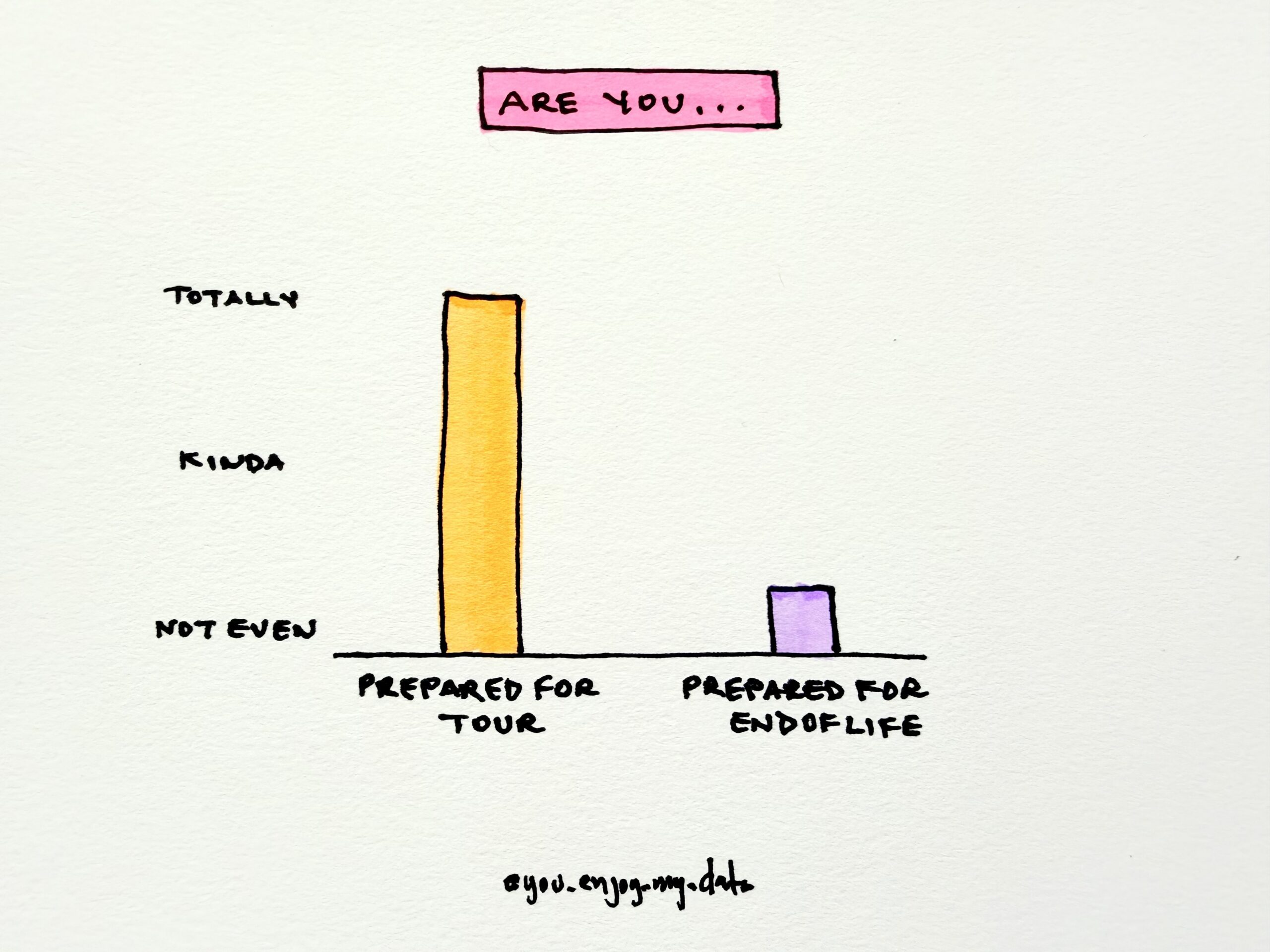
Created for Jam Band Graveyard by @you_enjoy_my_data.
Start here: write something down today
You don’t need a lawyer, a funeral home, or a formal document to begin. You need something written and someone who knows it exists.
The simplest version of planning ahead is a document—call it whatever you want—that answers a few questions:
- What do you want to happen to your body after you die? Burial, cremation, green burial, donation, or something else.
- Do you want a gathering? What would that look like?
- Who should be contacted when you die?
- Where are your important papers?
- Is there anything you specifically want or don’t want?
Write this down. Save it somewhere you can find it. Tell someone—at least one person you trust—that it exists and where it is.
A written plan gives the people handling your affairs something to follow—and means the people you love aren’t guessing while they’re already grieving. It isn’t a legal document and can’t override a will, a healthcare proxy, or a power of attorney. For those protections, the documents section below covers what to get and where to find it.
If you want to go further—advance directives, legal documents, conversations with a funeral home—the rest of this page will help prepare you for those conversations with the appropriate professionals. But start with the document.
What to decide
What happens to your body
This is the decision most people put off longest, and the one that creates the most difficulty for families when it’s left unaddressed. The main options in the United States:
Burial. In a cemetery, in a casket, with or without embalming. Traditional. Widely available. Costs vary significantly by location and provider.
Cremation. The most common disposition in the U.S. today. Cremated remains can be kept, scattered, buried, or divided. Doesn’t have to mean no gathering—a memorial can happen before, after, or completely separately from the cremation itself. If scattering matters to you, check local regulations before making plans—rules vary by location, and some places require permits or prohibit scattering. If you have a specific wish for where or how your remains are handled—scattered in a particular place, incorporated into something meaningful, kept together or divided—make sure the person carrying out your wishes knows that explicitly. A written note isn’t always enough; they need to hear it from you and know it matters.
Green or natural burial. Burial without embalming, in a biodegradable container or shroud, often without a concrete vault. Availability varies. If this matters to you, the Green Burial Council’s provider directory at greenburialcouncil.org lists certified providers by state.
Aquamation. Also called alkaline hydrolysis or water cremation. Legal in a growing number of states. A local funeral provider or your state’s funeral regulatory board can confirm whether it’s available where you are.
Whole body donation. Donation to a medical school or research program. Must be arranged in advance directly with the receiving program. Acceptance is not guaranteed. Before registering, get answers from the program directly: what happens if the donation is declined, who pays for transportation if it is, and what disposition your family should arrange as a backup. Document those answers alongside your other planning materials.
Natural organic reduction. Sometimes called human composting. Also legal in a growing number of states—check your state before making plans.
Organ and tissue donation. Standard organ and tissue donation—registering through your state’s donor registry—is a separate decision from your choice of disposition and is compatible with burial or cremation. If this matters to you, register and make sure your family knows your wishes.
One thing worth naming before you decide: if being present with the body—seeing them, sitting with them, having time before or during cremation—matters to those closest to you, some disposition choices and providers allow more of this than others. The window for presence can be short. Your written plan can include an explicit note about whether and how you want them to have that access.
For a full explanation of your rights when making arrangements—what you can ask for, what you’re entitled to, and what you can refuse—read Know Your Rights.
The gathering
A funeral and a disposition are not the same thing. You can decide what happens to your body separately from whether and how you want people to gather. Many people separate the two entirely.
Before you decide whether you want a gathering: the image most people are working from when they say they don’t want one is a specific thing—a funeral home, a casket at the front, a pastor reading from a script, a deli tray at someone’s house after. That version exists. It’s also one option among many, and for a lot of people in this community, it’s the least likely fit.
This community already knows how to gather around loss. The lot memorial at the next tour stop. The song dedication that turns three thousand people into one room of grief. The post that becomes a hundred people sharing stories about someone they all loved. The Yellow Balloon group thread that becomes a place to put what doesn’t have anywhere else to go. You’ve probably been part of one of these without calling it a memorial. That’s what it was—and you can make it intentional.
One thing worth saying directly: what you want for yourself and what those around you need are not always the same thing. Grief without a container is harder to hold. Without a gathering of some kind, the people who loved you are left carrying something that never had a place to land. A gathering doesn’t resolve grief. But it gives people somewhere to be in it together.
It’s also worth examining whether “I don’t want a gathering” means you genuinely don’t want one—or whether it means you don’t want to be a burden. Those are different answers that produce very different outcomes for the people you leave behind. Saying yes to a gathering is also saying: yes, you may come, yes, what we had mattered, yes, I will let you mourn me. For people who spend their lives not wanting to take up too much room, that’s the harder ask. It’s also an act of love.
One more thing: you don’t have to wait until you’re gone. The living wake—the dinner or the night or the afternoon where people come together while you’re still in the room—is one of the most profound things this community can do for each other. If that’s something you want, you can ask for it.
What gatherings have looked like—to help you think about what yours might be:
A small gathering at someone’s house with the albums that mattered playing through the night. A lot gathering at the next tour stop with a candle table and an open mic for stories. A Zoom with people from three decades and four time zones. A walk to a place that meant something, followed by food and talking. A celebration in a field. A setlist played in full by people who knew what it meant. A living wake, weeks before death, so the person dying gets to hear what they mean while they can still hear it.
Some questions worth sitting with:
- Do you want a gathering? If not—is that because you genuinely don’t want one, or because it feels like too much to ask?
- What image of a gathering are you working from? Is there a different version that would actually fit?
- Where would feel right—a place you love, a place the community gathers, somewhere that meant something?
- Who do you want there, and what do you want people to do?
- Is there music? Is there a setlist? Is there a song that closes the night?
- Is there a version of this you’d want to be present for—while you can still be in the room?
Whatever you decide: make it possible for the people who love you to get it right.
If you’re working through something harder than planning—grief, a difficult diagnosis, or something that’s hard to name—the Resources page has support for that too.
Documents and legal tools
A written plan is a start. Depending on your situation, other documents matter:
Advance directive (also called a living will or healthcare directive)—A legal document that tells healthcare providers and those closest to you what medical treatment you do and don’t want if you can’t communicate. This applies while you’re still alive and incapacitated. Free state-specific forms are available through CaringInfo at caringinfo.org.
Healthcare proxy or durable power of attorney for healthcare—Names a specific person to make medical decisions on your behalf if you can’t. If the person you want making decisions isn’t your legal next of kin, this document matters.
Durable power of attorney—Authorizes someone to handle your finances and legal affairs if you become incapacitated.
Will—Governs what happens to your property after you die. Does not govern what happens to your body, and may not be read until after burial or cremation decisions have already been made. Your written wishes about disposition should exist separately from your will and be findable immediately.
POLST or MOLST (Physician Orders for Life-Sustaining Treatment / Medical Orders for Life-Sustaining Treatment)—An advance directive is the right starting point for most adults. POLST is a separate tool—a medical order written by a physician that translates your wishes into standing orders medical personnel are required to follow. It’s appropriate when a serious illness or significant frailty makes that level of specificity necessary, and differs from an advance directive in that it travels with the patient across care settings. If that’s relevant to your situation, ask the treating physician whether a POLST applies. Availability and form names vary by state; polst.org has state-specific information.
None of these documents replace the others. If you don’t have them and something happens, those left handling your affairs may be without legal authority to carry out your wishes, or may face conflict about who has the right to decide.
If you want guidance on which documents fit your situation, talking to an estate planning attorney is worth the time. This page can point you in the right direction—it can’t give legal advice.
Who needs to know, and where to keep it
A plan no one can find is no plan at all.
Tell someone. At minimum, one person who is likely to be involved in your affairs needs to know: that a plan exists, where to find it, and that there are documents to look for. It doesn’t have to be a formal conversation.
Keep it findable. Not in a safe-deposit box that requires a death certificate to open. Not in a file no one knows about. Somewhere accessible—a physical folder, a shared document, a place the right people know to look.
Keep it current. If your relationships change, your location changes, your wishes change, or you acquire or lose significant assets, revisit the plan. A note with a date at the top, updated when something changes, is enough.
Consider digital accounts. Social media accounts, email, and cloud storage don’t transfer automatically at death. A brief note about your accounts and what you’d like done with them—memorialized, closed, or managed by someone specific—can save the people handling your affairs significant difficulty.
Having the conversation
Writing your wishes down is necessary. It isn’t sufficient.
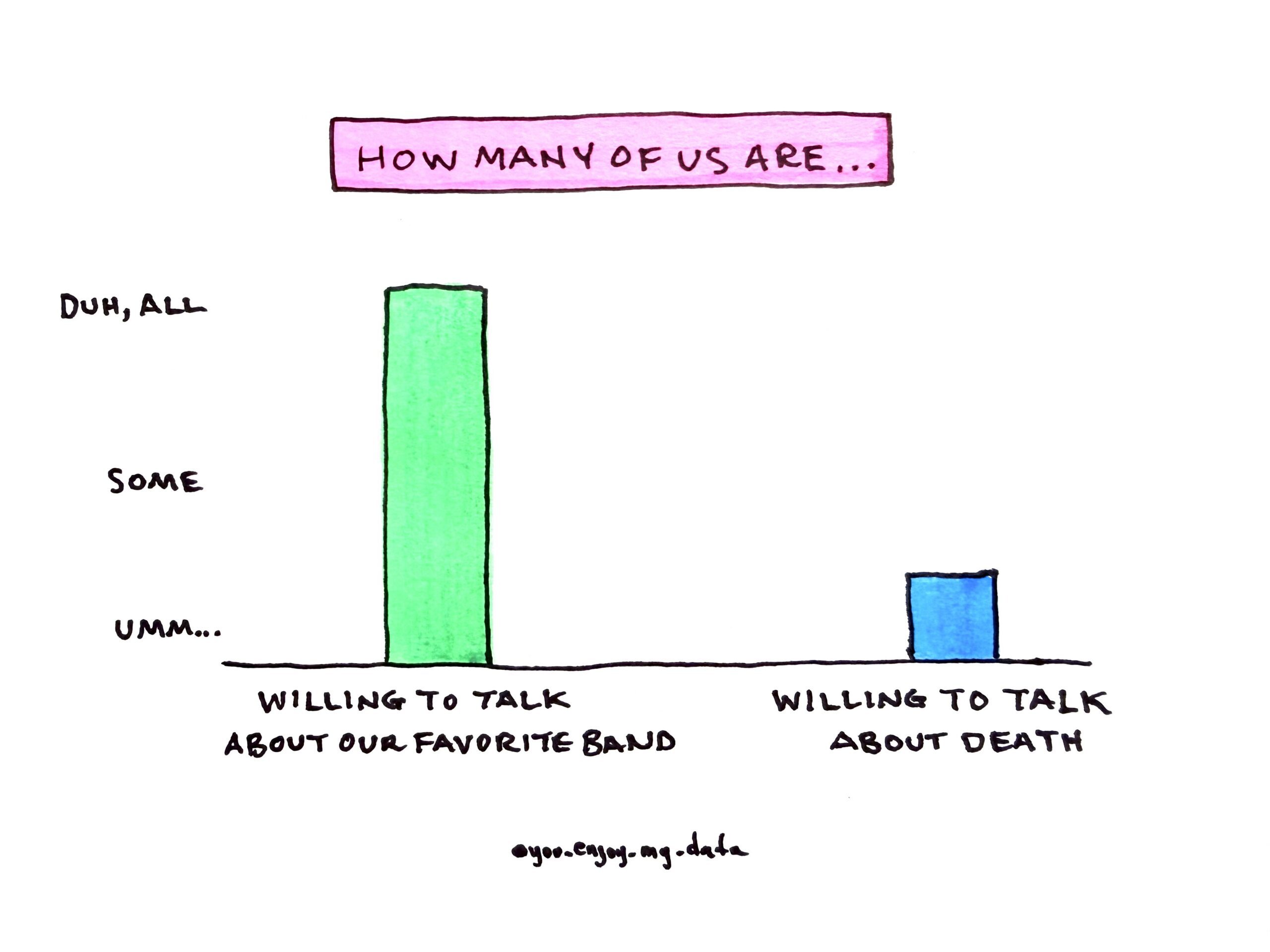
Created for Jam Band Graveyard by @you_enjoy_my_data.
In most states, next of kin holds legal authority over what happens to your body after you die—regardless of what you’ve written. If the people around you don’t know your wishes, or know them but aren’t in a position to advocate for them, a document alone may not change the outcome. The person who matters most isn’t the one who has your paperwork. It’s the one who will show up and speak for you when the decisions are being made.
That person needs to know what you want—and that you want them to be the one carrying it out.
This is the conversation worth having—not because it’s comfortable, but because it’s the difference between a plan and a plan that actually works.
Designate someone. Most states allow you to name an authorized agent or healthcare proxy—a specific person with legal standing to make decisions on your behalf. This designation matters most if the person you’d want making decisions isn’t your default next of kin: a partner who isn’t a spouse, a friend who knows you better than your family does, a sibling rather than a parent. Without documentation, the law determines who speaks for you. In most states that default follows a fixed hierarchy—spouse first, then adult children, then parents, then siblings—regardless of who you’d actually want making decisions. The right documents give your preferences a much stronger foundation.
The documents section of this page covers what a healthcare proxy is and where to get the forms. The harder part is the conversation itself—telling someone you trust that you want them in this role, what that means, and what you’d want them to do. If you’re not sure how to begin that conversation, The Conversation Project has free tools built for exactly this: theconversationproject.org.
If your honest answer is that there isn’t someone—that your relationships are complicated, your family is estranged, or you simply don’t have someone you’d trust with this—you’re not alone in that. Some states have nonprofit organizations and volunteer advocate programs that can help fill this role. Some counties have public programs that step in when someone has no suitable candidate. An elder law attorney can help you understand what options exist in your state—and if cost is a barrier, legal aid organizations may be able to help. CaringInfo at caringinfo.org is a good starting point for finding state-specific resources.
And if you want to think it through and practice the conversation before you have it—A Conversation with JBG is a place to do that.
If the person you ask says no, don’t take it personally—and don’t let it stop you from asking someone else. No is information, not a verdict.
Some nos are instinctive—a reaction to the weight of the question before the person has had time to sit with it. Some come from their own anxiety about death, not from anything about you or your relationship. Some come from genuine uncertainty: I wouldn’t know what to do isn’t a no to you—it’s a no to the unknown.
Don’t pressure anyone into the role. But if you get a no, it’s worth asking gently whether they’re comfortable sharing what’s behind it. Is it the idea of death that feels like too much right now? Is it uncertainty about what the role would actually involve? Those are different answers—and the second one is often a conversation you can have. You can tell them exactly what you want. You can walk them through what you’d be asking of them. You can make the role feel less like a burden and more like something they already know how to give.
Not every no will turn into a yes. Some people genuinely can’t hold this role, and that’s real. But some will, once they understand what you’re actually asking.
If you hear no, take a breath, thank them for being honest, and think about who else you trust enough to ask. The goal is finding the right person—not convincing the wrong one.
This kind of conversation tends to evolve. What doesn’t land today might open up later—try to leave it open and don’t add pressure.
Start somewhere. The conversation doesn’t have to be a formal sit-down. It can happen in a car, at a show, over food. It can start with this page—handing your phone to someone and saying, I’ve been thinking about this. It can start with the question: If something happened to me, would you know what I wanted?
That same capacity—the one that shows up without an announcement, that turns a setlist into a memorial and a group thread into something that holds people—extends to the conversations that make loss easier to navigate when it arrives.
Planning conversations belong in the same place.
For more on why these conversations matter—and how to start them—read Before Someone Else Has to Decide in What Remains.
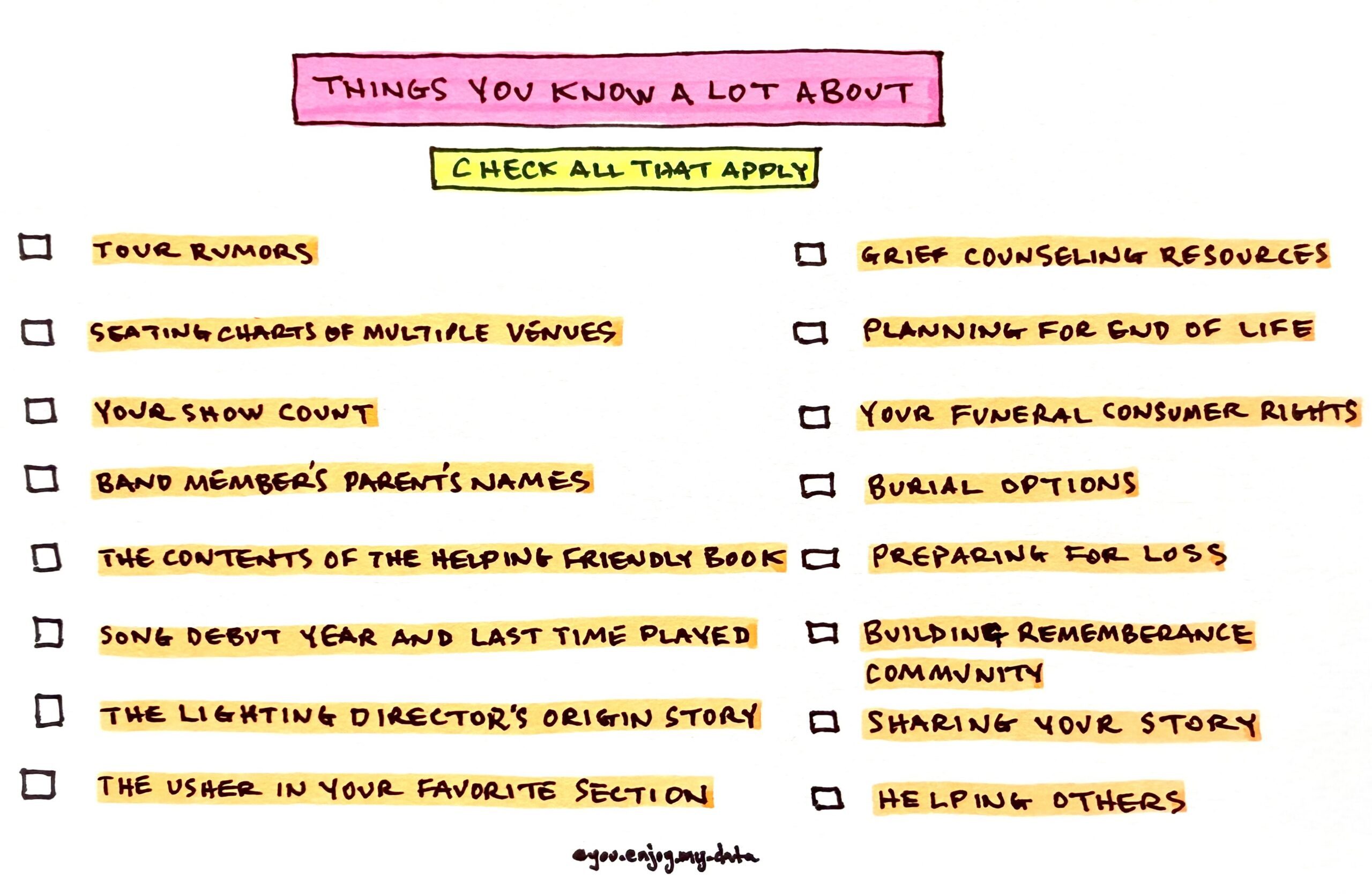
Created for Jam Band Graveyard by @you_enjoy_my_data.
The financial reality
Funeral arrangements are among the most expensive purchases most families make, often under time pressure and emotional weight. Knowing what things cost—and what you’re entitled to—matters.
- You have the right to itemized pricing from any funeral home.
- You do not have to buy a package.
- Funeral homes are required by law to give you itemized prices over the phone. You can call any funeral home, get their prices, and compare—without giving your name or any obligation.
- Direct cremation and direct burial are typically the least expensive options. Use them as your floor when comparing prices between providers—they tell you what arrangements cost at their simplest.
Before you prepay anything: Prepayment problems are documented and real. Funds have been misused, funeral homes have closed or changed ownership, and consumer protections vary significantly by state. Writing down your wishes and keeping funds in a designated savings account you control—a payable-on-death account at your bank is one common approach—carries less risk than a prepayment contract in many cases. Read the prepaying section of Know Your Rights before signing anything.
If cost is a primary concern: direct cremation is typically the least expensive option. Green burial is often less expensive than traditional burial. Some states and localities have nonprofit cemeteries or assistance programs—your state attorney general’s consumer protection office can point you toward what exists in your area. Veterans may be eligible for burial benefits through the Department of Veterans Affairs, including burial in a national cemetery at no cost. See the Planning Ahead section of our Resources page for more.
For a full explanation of what you’re entitled to and how to compare providers, read Know Your Rights.
Common questions
Is planning ahead morbid?
No. It’s one of the most practical things you can do for the people who will carry what you leave behind. It takes a hard task out of their hands during one of the hardest moments of their lives. The discomfort of thinking about your own death is real—so is the burden you leave behind when you don’t.
Do I have to use a funeral home?
For most disposition options, yes—at some point a licensed funeral provider is involved in the legal process of death certificate filing, permits, and disposition. But you have significant rights in how you engage with that provider: what you choose, what you pay for, and what you decline. You also have the right to use outside providers for things like caskets and urns without paying a handling fee. See Know Your Rights for the full picture.
What if my family doesn’t agree with my wishes?
Writing your wishes down and telling people while you’re alive gives your preferences the best chance of being honored. For decisions you feel strongly about—who makes decisions on your behalf, what happens to your body, how funds are handled—legal documents provide more protection than an informal written plan alone. An estate planning attorney can help you understand what documentation will protect which decisions in your state. If you anticipate conflict, that conversation is worth having now—not after something happens.
Does planning ahead mean I have to sign something with a funeral home now?
No. Writing down your wishes and sharing them with the people who need to know them requires no contract, no payment, and no commitment to any provider. A prepayment contract is a separate decision with its own considerations—see the financial section above.
What if I don’t have money for a funeral?
Direct cremation is the least expensive option in most places. If cost is a barrier, options exist: some counties provide no-cost cremation or burial for families who cannot cover expenses—contact your county medical examiner or public health office to ask what’s available. Some nonprofits and religious organizations also provide assistance. Know Your Rights covers the baseline options and what each involves. If you’re in immediate need after a death, the After a Death section of our Resources page is a good starting point.
A note on what this page is (and isn’t)
This page is general educational information. It’s not legal advice, it’s not a substitute for an estate planning attorney, and it’s not a preneed agreement with any funeral provider. Funeral, burial, cremation, advance planning, and consumer protection rules vary by state and can change. JBG aims to provide careful, good-faith guidance, but you should verify state-specific details and consult an appropriate professional where your situation calls for it.
Where to go from here
Know Your Rights—Your federal rights when making funeral arrangements. What you can ask for, what you can refuse, and what to do if something goes wrong.
Resources—The Planning Ahead section of our resource library, with tools for advance directives, healthcare proxies, and conversations with the people who need to know your wishes.
Something helped you that isn’t here—Planning looks different for everyone. If something made a difference in your process that isn’t on this page, we’d like to hear about it.